
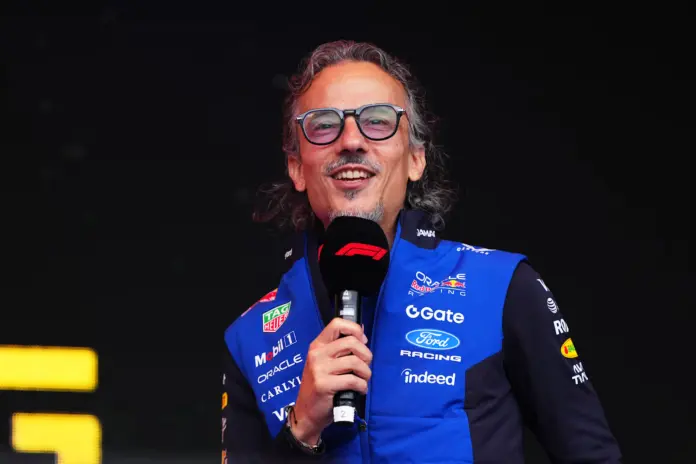
Isack Hadjar’s remarkable performance during the Belgian Grand Prix has drawn high praise from Red Bull’s Team Principal Laurent Mekies, who described it as his “best race with us, no question.” Starting from P21 due to a real grid penalty, Hadjar stormed through the field to finish in P6, showcasing impressive skill and strategy.
This performance underscores Red Bull’s ongoing development within the current FIA World Championship framework. Hadjar’s remarkable pace and racecraft highlight his increasing potential, a sentiment echoed by Mekies, according to the report by Formula 1.
Hadjar’s Strategic Race from P21 to P6
Isack Hadjar’s ascent through the Belgian Grand Prix field was a perfect drive in overtaking and strategic tyre management. Initially starting in P21 after incurring a 30-place grid penalty, Hadjar showcased resilience as he navigated the challenges presented by Spa-Francorchamps. His performance culminated in a strong sixth-place finish, that included a bold two-stop strategy aimed at capitalising on the circuit’s overtaking opportunities.
Mekies Highlights Hadjar’s Continuous Improvement
Laurent Mekies praised Hadjar’s consistent progression, noting that his performances have steadily improved race by race. “It’s not only a spike… he’s bringing some speed every time he’s driving,” Mekies remarked. The driver was fast in practice sessions and continued to demonstrate high pace throughout the race, reinforcing Red Bull’s confidence in his abilities.
The Role of Pit Strategy in Hadjar’s Success
Hadjar’s race strategy hinged on an early pit stop, which aimed to position him for a longer stint on hard tyres. Although this call required an additional third pit stop later in the race, it proved effective enough to maintain his competitive edge. Mekies acknowledged that the timing of a virtual safety car allowed Hadjar to achieve important overtaking opportunities, ultimately aiding him in holding off competitors like Lando Norris.
Red Bull’s Future Developments on Energy Management
Despite Hadjar’s success, Mekies emphasised that Red Bull still faces challenges in maximising performance across different circuits. He pointed out that energy management remains a important factor, particularly on energy-starved tracks. Looking ahead to future races, Mekies expressed optimism yet recognised the need for further exploration of the team’s capabilities in different conditions.
The SportiveNews view
Hadjar’s performance at the Belgian Grand Prix not only demonstrates his remarkable talent but also signals Red Bull’s strategic flexibility and adaptability. As the season progresses, unlocking consistent performance across various track types will be critical if the team aims to maintain its competitive edge in the championship standings, placing real emphasis on energy efficiency and tyre strategy.
Frequently asked questions
What was the impact of Hadjar’s grid penalty on his race strategy?
Hadjar faced a 30-place grid penalty that pushed him to the back of the grid. This situation forced him to employ a bold tyre strategy, making early pit stops to gain positions rapidly, which ultimately paid off with a sixth-place finish.
How did the virtual safety car affect Hadjar’s race?
The timing of the virtual safety car played a important role in Hadjar’s race strategy, providing him with an opportunity to make important overtakes that would secure his sixth-place finish, allowing him to take advantage of his tyre strategy effectively.