
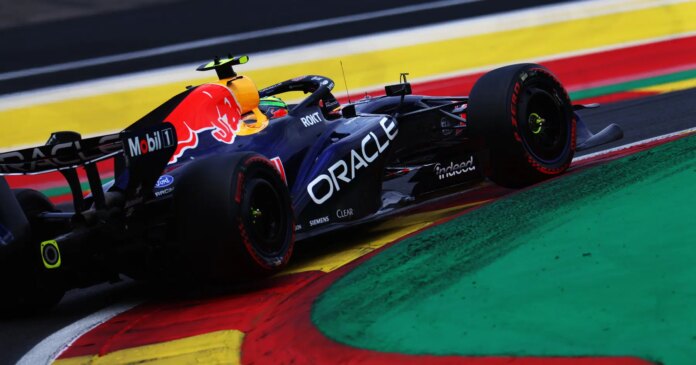
Isack Hadjar recently discussed the complexities involved in aiding Max Verstappen during the Belgian Grand Prix qualifying, humourously comparing his role to that of a “Deliveroo” service. Red Bull deployed Hadjar to provide a important tow in the final sector of the session, a decision influenced by Verstappen’s 30-place grid penalty due to power unit changes.
This strategic move proved effective, as Verstappen managed to secure second on the grid at Spa-Francorchamps, greatly improving his position, as he estimated he could have otherwise qualified in sixth or seventh. Hadjar’s contribution underscored the importance of teamwork in the fiercely competitive milieu of Formula 1.
Hadjar’s Challenging Role for Verstappen
Hadjar’s task was not without its difficulties, particularly given the unique operational challenges of the current power units. He indicated that predicting the engine’s response while trying to deliver the optimum tow was particularly tricky. “Very difficult,” he stated, elaborating on the erratic software reactions from the engine when transitioning between different power demands.
Understanding the Technical Nuances Post-Qualifying
The evolving technology in the cars has made traditional towing more complex this season. Hadjar highlighted that his initial attempts in Q3 were marred by power surges and insufficient delivery, complicating the execution of the strategy. Ultimately, he acknowledged it was a delicate balancing act, underscoring the precision required at this level of racing.
Hadjar’s Position Despite Setbacks
Although starting from 21st place due to his grid penalty, Hadjar demonstrated promising pace throughout the weekend. His decision to focus on supporting Verstappen rather than aggressively pursuing a personal lap time reflects a commendable team-first mentality. This approach may serve him well as he continues to develop his career within a dominant Red Bull framework.
The SportiveNews view
Hadjar’s contribution during qualifying may have secured a important position for Verstappen, showcasing the interdependence within teams. While Hadjar starts further back on the grid, his ability to perform under pressure and assist a championship contender could strengthen his standing within Red Bull. Success in this collaborative role could lead to further opportunities to showcase his talent on the track.
Frequently asked questions
What challenges did Isack Hadjar face while providing a tow to Verstappen?
Hadjar described the process as “very difficult,” emphasising the complications arising from engine power fluctuations when attempting to time the tow effectively. He noted issues with both excessive and insufficient power during critical moments in Q3, which hindered optimal cooperation.
How did Verstappen’s grid penalty influence the team’s qualifying strategy?
With a real 30-place grid penalty due to multiple power unit component changes, Red Bull utilised Hadjar’s strength in qualifying to ensure that Verstappen could benefit from a strategic tow, which ultimately facilitated a competitive start position despite the penalty.