
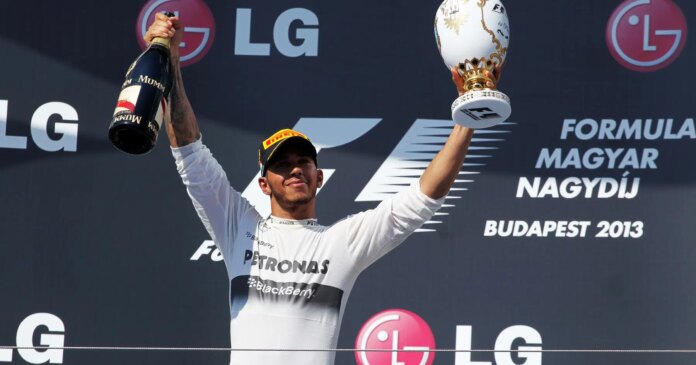
Lewis Hamilton marked a real milestone in his illustrious career on 28 July 2013, when he clinched his first victory with Mercedes at the Hungarian Grand Prix. This triumph not only distinguished his transition from McLaren but also ignited a transformative chapter for both Hamilton and the Silver Arrows, establishing a dominance in Formula 1 that has redefined the sport.
At this juncture in the FIA World Championship, Hamilton’s historic win twelve years ago serves as a backdrop to the ongoing evolution of Mercedes and its competitive standing. As highlighted by gptoday.com, this monumental occasion illustrates how important moments can shape the trajectory of both driver and team.
Hamilton’s Race Mastery at the Hungaroring
Hamilton’s victory in Budapest was characterised by his flawless execution of a daring three-stop strategy. On a track notorious for tyre degradation, particularly under the sweltering 35°C heat, the W04 proved a challenging machine. However, Hamilton’s skillful management of the race from pole position led him to triumph over rivals Kimi Räikkönen and Sebastian Vettel, signalling a potent combination of driver tenacity and strategic acumen that would become a hallmark of his career.
The Evolution of Mercedes as a Racing Powerhouse
From this inaugural win, Mercedes rapidly evolved into a strong force in Formula 1. Over the ensuing eleven seasons, Hamilton amassed an extraordinary 83 additional victories with the team, securing his status as the driver with the most wins for a single constructor. The period witnessed Mercedes clinching eight consecutive Constructors’ Championships from 2014 to 2021, establishing a historic dominance that places the team among the elite in sporting history.
The Records Set in Partnership with Mercedes
During his tenure with Mercedes, Hamilton shattered numerous records, including the milestones of 100 career wins and pole positions, outpacing the illustrious Michael Schumacher. With a total of 153 podium finishes under the Silver Arrows banner, Hamilton’s achievements are a testament to the unprecedented success arising from this partnership.
The Impact of the 2013 Hungarian Grand Prix on F1 History
This singular event in 2013 initiated a legacy that will shape the annals of Formula 1. Hamilton’s initial success paved the way for a remarkable transformation that not only elevated his career but also redefined Mercedes as a leading team within the sport. Even as he continues to race with Ferrari, the echo of that Hungarian win resonates as the genesis of an extraordinary era in F1 history.
The SportiveNews view
Hamilton’s initial victory with Mercedes at the Hungaroring is a important pivot in both his career and that of the team. As we reflect on this milestone, it’s evident that such strategic feats and resilience are important for teams aspiring to challenge the status quo. The legacy created has set high benchmarks for future competitors, influencing team dynamics and driver expectations in the championship.
Frequently asked questions
What was the weight of Hamilton’s first win with Mercedes?
Hamilton described his inaugural victory with Mercedes as one of the most important of his career, marking a important moment in his transition from McLaren and igniting a lasting partnership that would redefine both driver and team.
How did Mercedes perform following Hamilton’s landmark win?
After Hamilton’s first victory in 2013, Mercedes embarked on an unprecedented journey, securing eight consecutive Constructors’ Championships and establishing records that would elevate both the team’s and Hamilton’s legacy within Formula 1.