
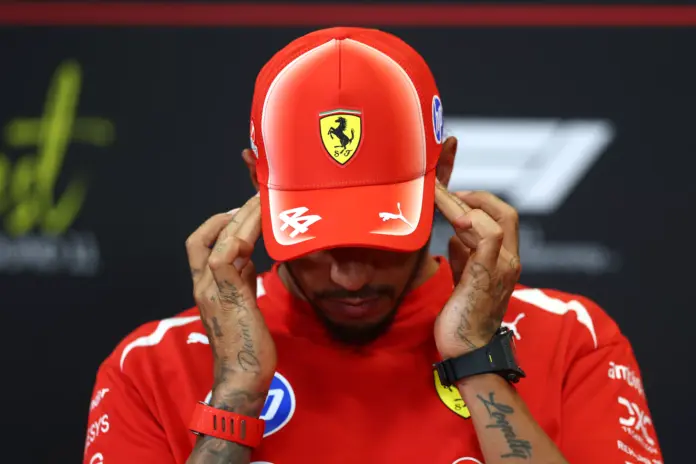
Lewis Hamilton faced disappointment at the Hungarian Grand Prix, finishing P5 due to a series of misfortunes that hampered his ability to leverage Ferrari’s pace. After commencing the day with high hopes following a P2 qualifying position, the British driver was set back by a three-place grid penalty for impeding Oscar Piastri in the qualifying rounds.
Hamilton’s performance exemplified the competitive nature of the current FIA World Championship, where strategic decisions and on-track incidents can dramatically alter race outcomes. According to reports from Formula 1 coverage, Hamilton’s struggles highlight a trend in the season where mistakes can lead to costly repercussions.
The setbacks that defined Hamilton’s race at the Hungaroring
Initially positioned well, Hamilton’s race took a hit with a grid penalty, forcing him into a damage limitation strategy. Starting on soft tyres—despite their efficiency—he lost important positions in a fierce contest with Max Verstappen. The driver sought to regain a podium position after a pit stop during a Virtual Safety Car phase but found himself impeded further by needing to allow Kimi Antonelli to pass, thus complicating his race strategy.
The impact of penalties and strategy on Hamilton’s results
Hamilton’s hopes for a podium were dashed when a five-second time penalty for speeding in the pit lane compounded his issues. This penalty, coupled with teammate Charles Leclerc’s closing pace in the latter stages, saw him finish fifth, a position far from where he had hoped to end the race. Hamilton expressed frustration, indicating that recent missteps had overshadowed his and the team’s efforts throughout the day.
Leclerc’s missed opportunities and Ferrari’s strategy
Charles Leclerc shared in the disappointment, unable to capitalise on his front-row start and ultimately finishing P4. The Monegasque driver noted that a poor launch at the start of the race severely impacted his chances for a strong finish. By opting for a similar strategy as Hamilton, he found himself trailing and accumulating more time behind competitors, which further reduced Ferrari’s potential to secure a podium.
The SportiveNews view
The Hungarian Grand Prix results underscore the challenges that both Hamilton and Leclerc face as they navigate a competitive field. With Hamilton admitting to a subpar performance in the first half of the season, it appears both drivers will need to hone their strategies and minimise errors if they are to secure better results moving forward in the championship.
Frequently asked questions
What caused Hamilton’s P5 finish at the Hungarian Grand Prix?
Hamilton’s P5 finish was a result of multiple factors including a three-place grid penalty for impeding Oscar Piastri, a five-second time penalty for speeding in the pit lane, and strategic decisions that did not play out as hoped during the race.
How did Leclerc’s performance at the Hungaroring influence Ferrari’s standings?
Leclerc’s inability to perform as expected, after starting in a front-row position, meant that Ferrari missed a real opportunity to leverage their pace. His position drop at the start and subsequent strategy miscalculations led him to finish P4, reflecting a wider issue for Ferrari in this race.