
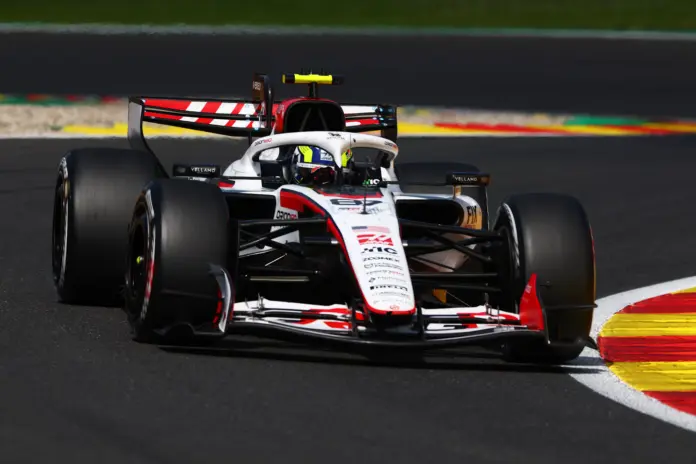
Haas’s drivers, Ollie Bearman and Esteban Ocon, faced a challenging outing at the 2026 Belgian Grand Prix, qualifying in P16 and P18, respectively. Both improved their positions due to grid penalties for other competitors, but first-lap contact led to pit stops for punctures. Ultimately, they finished in P14 and P17, marking the team’s fourth consecutive race without points.
This performance underscores the struggles Haas faces in the ongoing FIA World Championship, where the team is grappling with car dynamics and consistency issues. According to Formula1.com, while Bearsman and Ocon hoped for a solid race, various factors saw them unable to capitalise on their starting positions.
The early setbacks for Haas at Spa
Both drivers needed a strong start and a clean race to improve their standings, but an early collision hindered their progression. Despite benefiting from a safety car that followed George Russell’s incident, the race was largely compromised. The team’s reliance on two sets of hard tyres proved insufficient, and their finishing positions highlighted persistent difficulties.
Challenges with the VF-26’s performance
The VF-26’s lack of rear downforce emerged as a real issue throughout the event, further complicated by deployment problems. However, there were signs of improvement; a new front wing reportedly enhanced handling, instilling confidence in Bearman as he noted a better overall feel for the car. It indicates a path forward for Haas to extract missing performance in upcoming races.
Driver perspectives on the race
Bearman acknowledged that the car’s pace had improved compared to previous races, particularly in contrast to Williams. However, Ocon expressed frustration with ongoing inconsistencies that continue to hamper his performance. He emphasised the need for thorough investigations to identify underlying issues affecting the car’s behaviour, which he deemed critical for future success.
A team principal’s candid reflections
Team principal Ayao Komatsu admitted the VF-26 has faced inherent challenges since the season began. While upgrades introduced in Montreal are performing as expected, the fundamental handling characteristics of the car fall short of what is necessary. It’s a situation Komatsu aims to resolve through ongoing improvement processes, which he hopes will yield better results down the line.
The SportiveNews view
Haas’s ongoing performance struggles emphasise the important nature of car development and consistency within competition. While recent upgrades have positively influenced handling, the underlying issues affecting downforce usability remain. These factors jeopardise the team’s points-scoring potential, illustrating the critical need for further refinements ahead of the upcoming races.
Frequently asked questions
What issues have been identified with the VF-26?
The key issues affecting the VF-26 include a shortage of rear downforce and deployment problems that surfaced throughout the race weekend. Team principal Ayao Komatsu acknowledged these challenges have persisted since the season’s start, complicating the team’s performance on track.
How did the upgrades performed at Spa impact the race?
Although the upgrades made in Montreal aimed to enhance performance, they did not result in an immediate uptick in grid standings. Komatsu highlighted that while these parts have delivered on expected improvements, the car’s fundamental handling characteristics continue presenting real hurdles for the team.
For the latest technical updates in Formula 1, visit SportiveNews.