
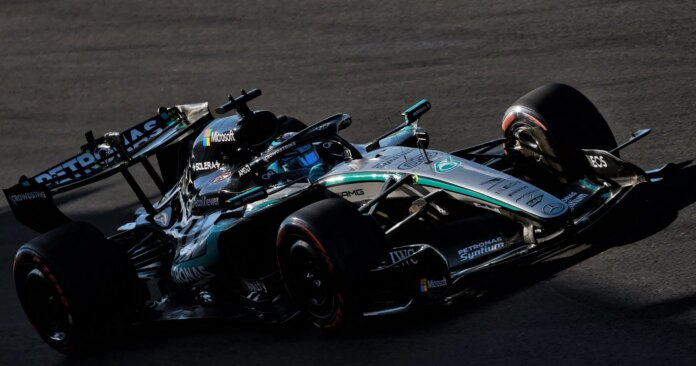
George Russell has acknowledged the challenges of adapting to a “different beast” at the Hungarian Grand Prix following the perplexing issues faced by Mercedes in Belgium. The British driver expressed confidence in the team’s efforts to resolve the issues that hindered his performance at Spa, particularly concerning straight-line speed.
During the recent race weekend at Spa-Francorchamps, Russell reported real difficulties, suggesting that a software glitch had contributed to a lack of energy management which ultimately cost him valuable time during qualifying. This was marked by a 0.4-second deficit compared to Kimi Antonelli, highlighting the impact of the issue and the resulting energy constraints at the unforgiving circuit. Conversely, the Hungaroring presents a contrasting challenge with its energy-rich configuration, characterised by its multitude of tight corners and heavy braking zones.
George Russell navigates new challenges at the Hungaroring
In the opening practice sessions in Budapest, Russell found himself marginally off the pace set by the dominant Ferraris. However, he held the belief that any lingering performance issues from Spa would be greatly mitigated at the Hungaroring, estimating only a 10% impact due to the circuit’s distinct characteristics.
Mercedes seeks to harness energy efficiently
Reflecting on the current scenario, Russell stated, “I didn’t really look at it to be honest, because I just trusted in the team that everything has been resolved.” He highlighted the advantages the Mercedes power units could exploit in Budapest, particularly noting that they could generate up to 350 kW out of every corner, enabling enhanced energy recovery and performance efficiency.
Windy conditions present added complexity for drivers
While Russell acknowledged the potential for improvement, he also referenced the challenging windy conditions affecting the team’s overall performance. He anticipated that shifting winds could greatly impact setup adjustments from Friday’s sessions to Saturday’s qualifiers, underscoring the importance of adapting in real-time. “We’ve got work to do as a team,” he stated, candidly critiquing the overall performance of the car thus far.
The SportiveNews view
Russell’s insights reveal a important transitional phase for Mercedes as they strive to recalibrate their performance after the obstacles faced at Spa. The team’s ability to navigate the differing characteristics of the Hungaroring may provide important momentum in the championship, setting the stage for a critical evaluation of their strategies as the season progresses. The disparity in circuit demands reflects the continuous evolution of race teams in adapting to technology and track conditions.
Frequently asked questions
What issues did George Russell face during the Spa weekend?
George Russell reported real straight-line speed deficiencies during the Spa weekend, attributing the issues to a probable software glitch. This impacted his energy management, resulting in a notable 0.4-second delay compared to competitor Kimi Antonelli during qualifying.
How does the Hungaroring impact Mercedes’ performance strategies?
The Hungaroring’s energy-rich format, with its stop-start nature and heavy braking zones, contrasts sharply with the energy-starved landscape of Spa. Russell believes this track’s characteristics will minimalise any lingering issues, stating that they would only represent about 10% of the challenges encountered in Belgium.
Formula 1 coverage continues to follow the developments in the championship, as Mercedes seeks clarification on their performance trajectory. As the team grapples with these technical challenges, timely adjustments will be important in their competitive strategy as the season unfolds; to keep up-to-date, visit the latest technical updates.