
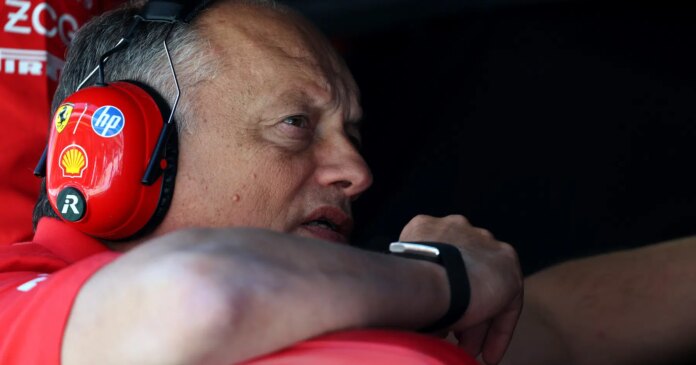
Fred Vasseur has publicly stated that not all of Lewis Hamilton’s recent F1 penalties should be viewed as identical. The Ferrari team principal’s comments come in the wake of Hamilton receiving a series of five-second time penalties at the British, Belgian, and Hungarian Grands Prix, each stemming from distinct incidents.
As the Formula 1 season progresses, Hamilton currently holds second place in the drivers’ championship, trailing leader Kimi Antonelli by precisely 50 points. The insights from Vasseur shed light on the controversial nature of the penalties Hamilton has encountered, as reported by GPToday.com.
Lewis Hamilton’s Penalties: A Breakdown of Incidents
In Silverstone, Hamilton was penalised for a false start while securing a third-place finish. His performance at Spa saw him involved in a collision with George Russell, which ended Russell’s race and led to another five-second penalty. Also, during the Hungarian GP, Hamilton received a pit-lane speeding penalty for exceeding the 80kph speed limit after pitting under a virtual safety car scenario.
Vasseur’s Perspective on Racing Incidents
Vasseur maintained that the collision involving Hamilton and Russell was, in his view, a legitimate racing incident, arguing that Hamilton acted within reasonable limits. Vasseur suggested that if faced with the same situation again, he would not advise Hamilton to change his approach, indicating a belief in the driver’s instincts in high-pressure scenarios.
Assessing the Impact of Recent Penalties
Despite the spate of penalties, Hamilton has shown resilience in his performances. However, Vasseur pointed to an accumulation of minor errors contributing to the Hungarian penalty, asserting that Hamilton’s pit-stop timing and execution were important. The marginal 0.1kph overspeed was highlighted, serving as a reminder of the razor-thin margins in Formula 1.
The SportiveNews view
Hamilton’s recent penalties illustrate the precarious nature of competitive racing, where mistakes can compound rapidly and have real consequences. Vasseur’s delineation of the incidents suggests a need for nuanced understanding rather than blanket assessments of fault, reflecting broader issues of penalty consistency in F1. As Hamilton seeks to leverage his experience in the championship race, his ability to avoid further penalties could prove important as the season unfolds.
Frequently asked questions
What led to Lewis Hamilton’s penalties in recent races?
Hamilton received five-second time penalties for various incidents in three different races: a false start in Silverstone, causing a collision with George Russell in Spa, and exceeding the pit-lane speed limit in Budapest.
How does Fred Vasseur view Hamilton’s spate of penalties?
Vasseur believes that not all of Hamilton’s penalties can be categorised similarly. He argues that the crash with Russell was a racing incident and attributes Hamilton’s pit-lane speeding penalty to a series of errors rather than a singular lapse in judgment.
What is the current status of the drivers’ championship?
As the summer break approaches, Hamilton sits in second place in the drivers’ championship, exactly 50 points behind Kimi Antonelli, highlighting the importance of consistency moving forward.