
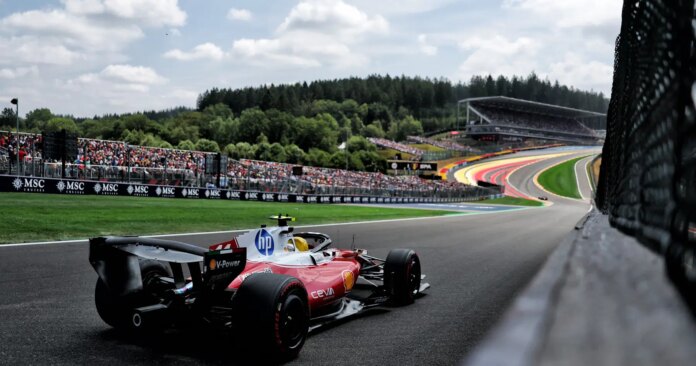
Ferrari’s SF-26 is set to debut a new rear wing configuration at the Hungaroring for the upcoming Grand Prix, tailored specifically to the circuit’s demands for high downforce. Following a promising performance at the Belgian Grand Prix, the team hopes to build on that momentum, particularly with Charles Leclerc and Lewis Hamilton also opting for high-downforce setups.
As the Formula 1 season progresses, speculation regarding Ferrari’s advancements has increased. According to Gptoday.com, the changes to the rear wing have generated both excitement and confusion within the paddock, leading to misperceptions about what modifications have been made.
Ferrari’s Adaptation for the Hungaroring’s Unique Demands
Ferrari’s rear wing for the Hungarian Grand Prix will not feature an upgraded version of the unusual “Macarena” tilting mechanism that has garnered attention. Instead, the team is implementing two smaller profiles added to the trailing edge of the existing wing design. This approach aligns well with the track’s requirement for maximum aerodynamic downforce.
The modifications are intended to enhance local downforce and allow for greater airflow management when the wing is in its fully open and tilted position. This circuit-specific adjustment is designed exclusively for the Hungaroring and does not signal any broader evolution of the existing wing technology.
Clarifying the Misleading Narratives Surrounding the Changes
It’s important to distinguish between the high-downforce adaptation for Hungary and the ongoing development of a true Macarena 2.0. While the Hungarian modification focuses on creating high drag for low-speed corners, the upcoming Macarena 2.0 aims to reduce drag for high-speed circuits, such as Monza, where straight-line speed is important.
The contrasting goals of these developments highlight a important distinction that some commentators may overlook, incorrectly branding the Hungarian adaptation as a real technological development rather than a focused response to this specific circuit’s requirements.
The Implications of Ferrari’s Development Strategy
Ferrari’s decision to implement a circuit-specific modification instead of a new version of the Macarena framework underscores a pragmatic approach to performance. The team’s aerodynamic department is simultaneously working on a more advanced iteration, with aspirations to debut at Monza—indicating a broader strategy that accommodates both varied circuit requirements and developmental timelines.
The SportiveNews view
The adaptations made to the SF-26’s rear wing for the Hungaroring represent a calculated strategy that underscores Ferrari’s commitment to maximizing performance at each event. By focusing on localized modifications while concurrently developing the Macarena 2.0 for future high-speed circuits, the team displays an adept balance of immediate and long-term performance objectives, important for its championship aspirations.
Frequently asked questions
What specific changes have been made to Ferrari’s rear wing for the Hungarian GP?
The rear wing modification for the Hungarian Grand Prix involves adding two smaller profiles to the trailing edge, designed to enhance local downforce. This adaptation is tailored specifically for the high-downforce requirements of the Hungaroring and is not a revised version of the existing “Macarena” wing.
When can we expect the Macarena 2.0 to debut?
The true Macarena 2.0, which aims to reduce drag for high-speed circuits, is under development. It is expected to make its competitive debut at Monza during the Italian Grand Prix, indicating Ferrari’s ongoing commitment to enhancing its aerodynamic capabilities across different racing environments.
For more insights on this and other developments in Formula 1, check our Formula 1 coverage and stay tuned for latest technical updates about the SF-26.