
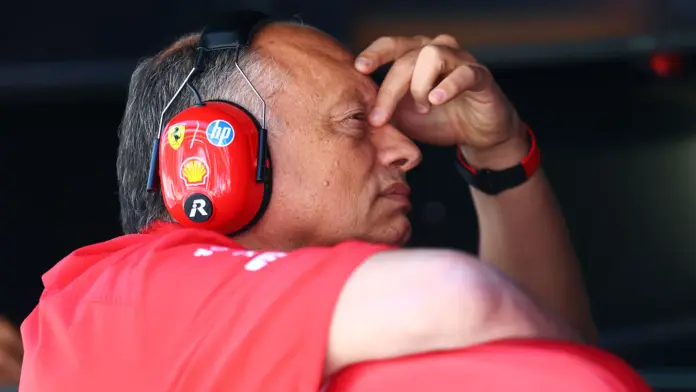
Ferrari’s performance during the 2026 Formula 1 Hungarian Grand Prix has drawn sharp criticism from Team Principal Fred Vasseur, who lamented that “everything went wrong” as both Charles Leclerc and Lewis Hamilton failed to secure a podium finish. The Scuderia had high hopes for a competitive outing at the Hungaroring, given the circuit’s layout was anticipated to favour the strengths of their 2026 car.
Vasseur’s remarks come as a stark acknowledgment of the challenges faced by Ferrari in the current championship context. The disappointing results were unexpected given their strong showing during practice sessions, with insights sourced from Formula1.com.
Ferrari’s Early Promise and Disappointing Outcome
Both Leclerc and Hamilton showcased competitive pace in preliminary practice, setting expectations for the race. However, a disappointing grid position saw Leclerc starting in P2 and Hamilton in P5, compounded by a penalty affecting Hamilton’s positioning after his initial lap challenges. The decision to start on soft tyres instead of mediums failed to yield the desired results, with both drivers struggling to advance in the opening stages.
Hamilton’s Fight but Failed Strategy
During the race, Hamilton engaged in a vigorous battle with Max Verstappen for the podium. Despite temporarily overtaking Verstappen after their first pit stop, he ultimately lost position at Turn 1. A later pit stop decision, combined with a penalty for exceeding the speed limit, culminated in Hamilton finishing P5 behind Leclerc, who could not manage a challenge for higher positions either.
Vasseur’s Call for Improvement
Vasseur did not hold back in his critique post-race, pinpointing Execution as an area for improvement. “It’s difficult to really understand the pace because you learn the fact that first it’s not a good Sunday,” he noted, expressing disappointment after securing P1 and P2 in Friday practice. The team’s inability to translate practice speed into race success has raised questions about their overall strategy and execution under pressure.
The Path to Recovery for Ferrari
Despite making noticeable progress in closing the performance gap to competitors, particularly the Mercedes team, Vasseur emphasised that mere upgrades are insufficient. Improvements are anticipated on the engine side, along with adjustments to their operational protocols, signalling a need for a deeper strategic overhaul as Ferrari prepares for the remainder of the season.
The SportiveNews view
Ferrari’s struggles during the Hungarian Grand Prix illustrate the real gap between potential and performance. While the team has shown improvements in pace, their failure to convert that into results signifies a important need for strategic refinement and operational excellence. The upcoming races will be important for restoring competitive momentum as they confront their performance weaknesses head-on.
Frequently asked questions
What factors contributed to Ferrari’s poor performance in Hungary?
Multiple elements impacted Ferrari’s race outcome, including strategic miscalculations regarding tyre choices and timing during pit stops. The combination of penalties and slower pace compared to rivals ultimately hindered both drivers’ attempts to secure points. Vasseur highlighted a series of operational mistakes as contributing to the disappointing results.
How has this outcome affected Ferrari’s standing in the championship?
Although Ferrari has made strides in reducing the performance gap to Mercedes, the lack of podium finishes in Hungary hampers their championship ambitions. Hamilton’s position relative to Kimi Antonelli has widened to 50 points, underscoring a pressing need for Ferrari to enhance their competitiveness as the season progresses.