
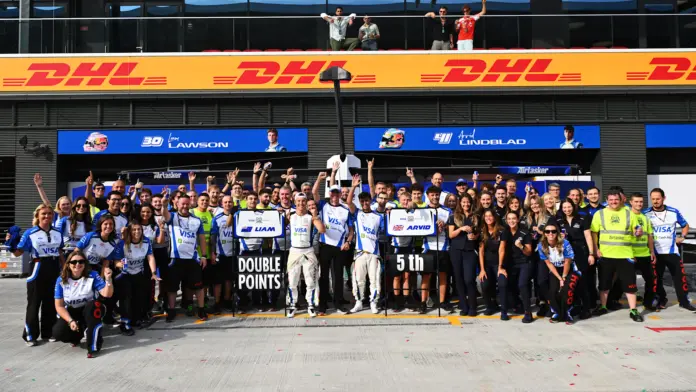
Liam Lawson showcased his racecraft at the 2026 Hungarian Grand Prix, outmaneuvering his Racing Bulls teammate Arvid Lindblad with a strategic two-stop pit strategy that proved decisive in ensuring both drivers scored points. While Lawson initially battled from behind, ultimately finishing in P8, Lindblad struggled with tyre longevity and was relegated to P10.
This race solidifies the competitive landscape of the 2026 FIA Formula 1 World Championship. As per sources from Formula 1 coverage, the split strategy employed by Racing Bulls has highlighted their adaptability, even amidst challenging race conditions, ensuring both drivers remained in the points as the season unfolds.
How Lawson Surged Ahead at the Start
Beginning the race, Lawson capitalised on a strong start, moving up from his initial grid position. Despite Lindblad’s better qualifying performance—starting P7 while Lawson started P9—the New Zealander made an impressive jump off the line, overtaking both his rivals and gaining P8 early on. Lindblad acknowledged his less-than-ideal start, admitting, “It wasn’t a great Lap 1,” confirming his disappointment at missing opportunities on the opening lap.
The Key Strategies Employed by Racing Bulls
Both Racing Bulls drivers aimed for a one-stop strategy with a focus on tyre management. This plan was disrupted when Nico Hülkenberg’s Audi forced a strategic rethink. After an early pit stop for Lindblad on Lap 20, Lawson was called in a lap later, allowing him to maintain an edge. Lindblad remarked, “I was saying I think it could be a two,” which underscored the team’s flexibility in strategy during the race.
Lindblad’s Struggle with Tyre Degradation
As the race wore on, it became evident that Lindblad was adversely affected by the high temperature and his decision to stick with the one-stop plan. His stint on hard tyres lasted an exhausting 49 laps, ultimately compromising his race pace. He admitted, “It was a bit of a shame the one-stop didn’t work,” recognising that while the strategy had potential rewards, it ultimately did not deliver the desired outcome.
Lawson’s Late Race Charge
Lawson capitalised on his fresher soft tyres in the latter laps, demonstrating superior pace that allowed him to successfully overtake Lindblad on Lap 62. This move not only secured him P8 but also ensured he capitalised on the two-stop strategy to its fullest. Reflecting on the race, Lawson commented on the unexpectedness of the two-stop decision, stating, “It was a great call from the team, and the car’s been really, really strong today.”
The SportiveNews view
The tactics deployed by Racing Bulls at the Hungarian Grand Prix illustrate not just the importance of adaptability in Formula 1, but also highlight Lawson’s growing prowess in utilising team strategies effectively. This race reinforces the potential trajectory for both drivers in the championship context, with team dynamics and individual race performances continuing to shape their season’s narrative.
Frequently asked questions
Why did Racing Bulls decide to split strategies during the race?
Racing Bulls opted for divergent strategies primarily due to the performance of Nico Hülkenberg, who triggered the two-stop strategy. This decision allowed Lawson to outperform Lindblad, who chose to stay on a one-stop plan despite recent hot race conditions that increased tyre wear concerns.
What factors contributed to Lindblad’s slower pace during the race?
Lindblad’s struggles were predominantly due to the ageing hard tyres he was on for a lengthy stint. After a disappointing start, he found himself unable to maintain competitive pace, stating that recent warm races made him cautious about excessive tyre wear, ultimately leading to his drop in position by the end of the race.