
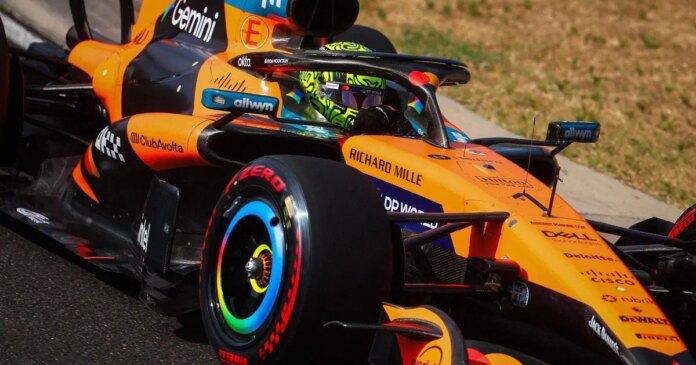
Lando Norris secured pole position at the Hungarian Grand Prix, with his McLaren MCL40 clocking in just 0.012s quicker than Lewis Hamilton’s Ferrari SF-26. However, Hamilton’s performance was overshadowed by a three-place grid penalty for impeding Oscar Piastri, further complicating his championship aspirations.
This result marks a critical moment in the ever-evolving landscape of the current Formula 1 season. Reported by GPToday, McLaren’s progress, particularly their ability to perform well on the manoeuvrable Hungaroring, underscores the merits of their recent technical upgrades.
The impact of short wheelbase on McLaren’s performance
McLaren’s design, characterised by the shortest wheelbase on the grid, has often influenced their handling dynamics. The limitations posed by this design choice were primarily attributed to load distribution challenges, impacting performance adversely in various conditions. The team’s decision aimed to address weight issues prevalent since the advent of the 2026 regulations, requiring a careful balance between handling and stability.
New underbody design enhances balance
The recent updates, particularly the reconfigured underbody, have greatly enhanced the car’s airflow extraction, presenting a solution to the previously encountered stability issues. While these upgrades show promising results in Hungary, their real potential will only be accurately assessed on faster circuits, such as Monza, where downforce generation is critical.
Suspension adjustments and ride height considerations
In Hungary, McLaren opted for a less rigid suspension setup and increased ride heights to tackle the circuit’s unique curbs. These adjustments reflect a strategic adaptation to track conditions, allowing the team to optimise grip and maintain better balance during high-speed cornering. The changes are indicative of a broader effort to refine the car’s overall performance characteristics, particularly as the team prepares for faster tracks.
Evaluating the ‘Macarena’ wing’s potential
The recent introduction of the “Macarena” wing during the Hungarian Grand Prix signals an ambitious shift in McLaren’s design philosophy. Scheduled for further deployment in faster layouts like Monza, this wing design aims to leverage aerodynamic advantages that could redefine the car’s competitive edge in upcoming races.
The SportiveNews view
McLaren’s resurgence, marked by Norris’s pole position and effective upgrades, suggests a strategic transformation for the team. With enhancements in handling and balance, they appear well-positioned to challenge more effectively in the latter part of the season. Continued evaluation at high-speed circuits will be important to solidifying their competitive trajectory.
Frequently asked questions
What has contributed to McLaren’s improved performance in Hungary?
McLaren’s performance improvement can be attributed to their recent technical upgrades, the reconfigured underbody which enhances airflow extraction and overall balance. Adjustments to the suspension setup and ride height also catered to the unique demands of the Hungaroring.
How does the short wheelbase affect McLaren’s car stability?
The short wheelbase has posed challenges regarding stability, rendering the vehicle overly sensitive to balance changes. While this design aimed to tackle weight issues, it initially compromised the car’s handling, a problem the team is actively addressing through their upgrades.
For ongoing insights, visit our comprehensive Formula 1 coverage and stay updated with the latest technical updates.