
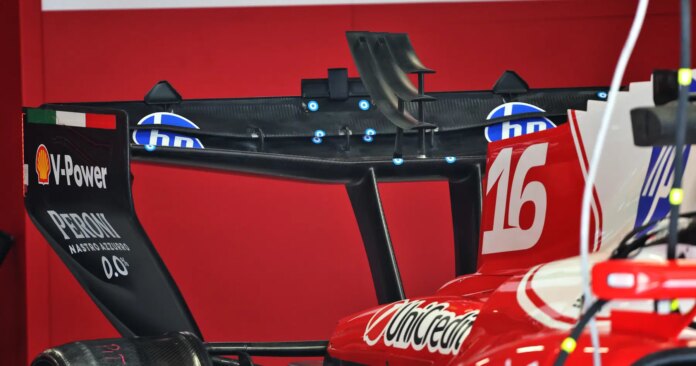
Ferrari and Mercedes are currently locked in an intense battle over aerodynamic advancements as they prepare for the Hungaroring, a circuit known for its challenging layout that mirrors the demands of Monaco. Both teams have committed to maximising downforce, exploiting the unique characteristics of the track, which allows for innovative developments that would be impractical elsewhere.
This competition unfolds in the context of the ongoing FIA World Championship, where teams are aggressively pursuing advancements to enhance performance. As reported by GPToday, the Hungaroring serves as a key arena for engineers to unveil ambitious aerodynamic concepts, highlighting the critical role of downforce in achieving competitive laps.
Ferrari’s Advanced Aerodynamic Philosophy at the Hungaroring
Ferrari’s latest SF-26 showcases an ambitious aerodynamic philosophy with a distinctive rear wing configuration. , this wing incorporates a triple-element structure affixed to the mainplane, along with three more profiles positioned at the trailing edge. This ambitious design choice clearly illustrates Ferrari’s commitment to achieving optimal downforce, capitalising on the circuit’s favourable conditions.
Mercedes’ Innovative Rear Wing Mechanism
Mercedes has not been idle in this competitive exchange. Its W17 model features a sophisticated central trailing-edge assembly, integrating an extra profile connected to a linkage system that manages the rear flap’s function. This intricate mechanism not only enhances airflow management but also strategically directs it, enhancing overall aerodynamic efficiency—an initiative that draws attention to Mercedes’ technical prowess.
Common Ground in Design Concepts Between Two Giants
The engineering teams of both Ferrari and Mercedes have inadvertently converged in their aerodynamic philosophies, as evidenced by the similarities observed in their latest rear-wing designs. Both configurations are tailored specifically to circuits like the Hungaroring and Monaco, underlining the emphasis on downforce and airflow management. This pursuit illustrates how even minor components can drastically impact performance when optimised for specific track conditions.
The Road Ahead for Ferrari and Mercedes
Looking ahead, the similarities in design philosophy between Ferrari and Mercedes signal a trend that could influence performance metrics at upcoming circuits, including Zandvoort. These developments not only showcase each team’s engineering excellence but also heighten the anticipation for what could unfold as they continue this technical duel throughout the season.
The SportiveNews view
The ongoing aerodynamic arms race between Ferrari and Mercedes at the Hungaroring exemplifies a critical point in the championship’s trajectory. As both teams innovate to increase downforce, the effectiveness of these configurations will be indicative of their relative standings in the championship race. Monitoring these developments is essential as the teams prepare for future circuits that reward similar aerodynamic capabilities.
Frequently asked questions
What specific aerodynamic features does Ferrari’s SF-26 include?
The SF-26 features a rear wing with an advanced triple-element configuration mounted on the main plane. Also, it has three further profiles along the trailing edge, illustrating Ferrari’s commitment to maximising downforce in challenging aerodynamic conditions.
How does Mercedes’ W17 contribute to its aerodynamic efficiency?
Mercedes’ W17 boasts an intricate central trailing-edge assembly, where an extra profile integrates with a linkage system used for flap operation. This mechanism not only enhances aerodynamic efficiency but also directs airflow, optimising the overall performance of the rear wing in competitive scenarios.
For more insights, visit our Formula 1 coverage and stay updated with the latest technical updates.