
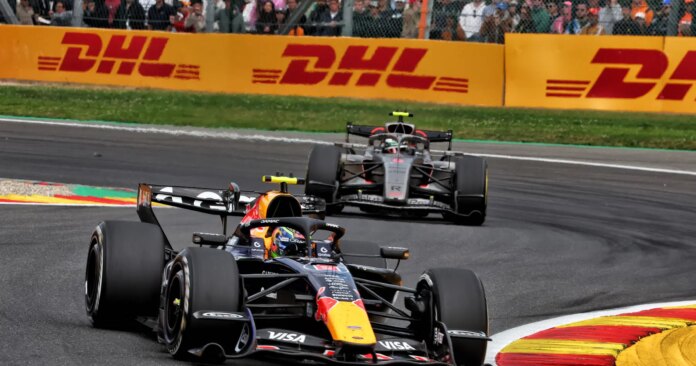
Isack Hadjar demonstrated impressive resilience during the Belgian Grand Prix, moving from the rear of the grid to finish in sixth place. The Red Bull driver highlighted his “strong race pace” at Spa-Francorchamps, reflecting on a well-executed two-stop strategy that he attributed to his successful performance despite starting from P21 due to a heavy grid penalty.
This race encapsulated Hadjar’s ongoing struggles and triumphs this season, showcasing not only his skill but also the competitive potential of the RB22 chassis. According to the source, the Belgian Grand Prix revealed a potent pace that had previously gone unrecognized, particularly hindered by grid penalties. , team-mate Max Verstappen’s third-place finish further underscored the team’s capabilities, as reported by Gptoday.com.
Isack Hadjar’s Surge from the Back of the Grid
Hadjar quickly initiated his comeback, overtaking multiple competitors on the first lap following the start. Aided by an early safety car, he employed a strategic pitstop cycle, switching to soft tyres before making a transition to hard compounds to complete the race distance. This adept navigation of the race’s early challenges and timely pit strategies played a critical role in his impressive recovery.
The Impact of Penalties on Performance Potential
Hadjar expressed disappointment regarding the penalties that impeded his qualifying position, which he believed could have placed him in contention for a podium finish. “I feel like if I just do the weekend without any penalties, I think we’re fighting for the podium,” he stated, capturing the overarching frustration that team members may share. His qualifying pace suggested that a top-five starting point was attainable, had it not been for the grid penalties.
Assessing the Race Pace and Strategic Decisions
Even with challenges disrupting his progression, Hadjar remained confident in his ability to extract performance from the car. Reflecting on his weekend, he noted, “It’s not… surprising in a way that I didn’t believe a track like this would suit us, but not really surprised in terms of my own performance.” This sentiment aligns with his commitment to maintain momentum in upcoming races as he continues striving for a stronger showing.
The SportiveNews view
Hadjar’s performance at Spa-Francorchamps highlights real promise for the Red Bull driver as he aims to capitalize on his newfound pace. The sixth-place finish not only illustrates his potential but also raises questions about the enduring impact of grid penalties on his championship trajectory. Should Hadjar manage to eliminate these setbacks, he could emerge as a reliable contender for podiums in subsequent races.
Frequently asked questions
What strategy did Isack Hadjar use during the race?
Hadjar implemented a bold two-stop strategy, closely linked to the early deployment of the safety car. This allowed him to cycle through soft tyres before switching to hard compounds, which enabled his remarkable recovery from the rear of the grid to a sixth-place finish.
How did grid penalties affect Isack Hadjar’s performance at Spa?
The 30-place grid penalty Hadjar incurred for exceeding his power unit allocation necessitated a P21 start. He felt that without these penalties, a top-five qualifying position—and possibly a podium finish—was achievable, given the RB22’s competitiveness at the circuit.
For more insights, follow our Formula 1 coverage and stay updated on the latest technical updates from the paddock.