
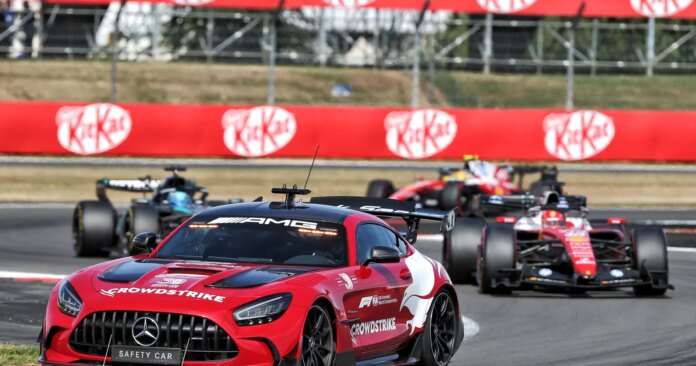
Lewis Hamilton has expressed his willingness for the FIA race director to exercise more discretion in red-flagging races, particularly during the latter stages, to guarantee a thrilling conclusion without the influence of safety cars. His comments follow the controversial ending of the British Grand Prix at Silverstone, which concluded under the safety car.
The recent race stirred debate in the Formula 1 community after a crash involving Max Verstappen prompted expectations for a late safety car withdrawal, enabling a final racing lap. However, the regulations were strictly adhered to, leading to Charles Leclerc securing victory without any last-minute overtaking opportunities. The FIA attributed the ‘Safety Car in this Lap’ message to a “software error.”
Hamilton’s Experience with Race Finishes
Reflecting on past incidents, Hamilton recalled the 2021 Azerbaijan Grand Prix, where a late red flag led to a dramatic two-lap sprint race. Similarly, he highlighted the 2023 Australian GP, which saw a late red flag for debris after Kevin Magnussen’s crash, concluding with a chaotic finish marred by multiple collisions, ultimately finishing behind the safety car.
Calls for Change from Drivers
When asked if he would support increased leeway for race directors in red-flagging races near the end, Hamilton responded positively. He articulated that the excitement of a racing finish is important for fans and believes that allowing more flexibility could greatly enhance the overall experience. He commented, “It happened in Australia, and it was like one of the best races,” indicating the positive impact of such decisions.
Regulatory Implications for the FIA
This revelation from Hamilton opens discussions about potentially revising safety protocols and race regulations. The FIA maintains strict adherence to rules to ensure fairness and adherence to competitive integrity. However, the growing call from drivers for a re-evaluation of these measures might push the governing body to consider updates to appeal to fans seeking more dynamic finishes.
The SportiveNews view
Hamilton’s advocacy for greater discretion in race management underscores a fundamental tension in motorsport: balancing safety with thrilling spectacle. As Formula 1 continually evolves, understanding and potentially adapting regulations could transform how fans and drivers engage with the sport. This could enhance championship narratives, offering more engaging climaxes, reflecting a modern audience’s expectations.
Frequently asked questions
What prompted Hamilton’s comments about red flags?
Hamilton’s remarks were triggered by the controversial finish of the British GP at Silverstone, where a late safety car prevented overtaking opportunities and led to an anti-climactic conclusion of the race.
How did recent races influence Hamilton’s views?
Hamilton cited recent instances, such as the dramatic Australian GP finish, as examples where red flags enhanced race excitement, leading him to advocate for similar measures in future races to avoid another finish under the safety car.
Formula 1 coverage and further discussion about Hamilton’s perspectives indicate a important crossroad for race management in Formula 1, urging fans and officials alike to reconsider the traditional approach to finishing races. As discussions continue, Hamilton’s stance might signal a real shift in the sport’s approach towards fan engagement and race excitement.