
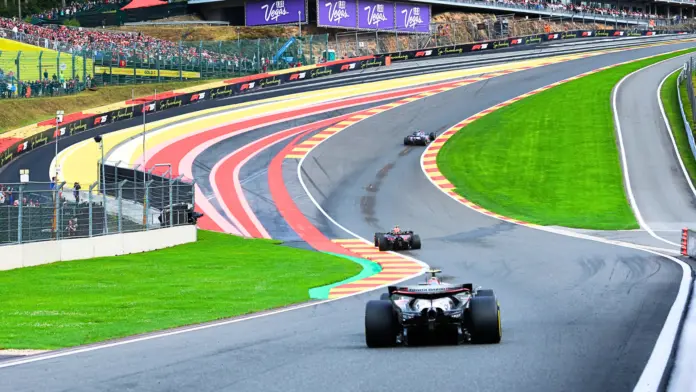
As anticipation builds for the forthcoming Belgian Grand Prix, the 2026 Formula 1 season approaches its tenth event at Spa-Francorchamps, a circuit renowned for its rich history and challenging layout. The race weekend kicks off with Free Practice 1 and 2 on Friday, July 17, followed by Free Practice 3 and Qualifying on Saturday, July 18, culminating in the race on Sunday, July 19.
Situated in the heart of the current championship battle, the Belgian Grand Prix presents important implications for several contenders. Sources from Formula 1 indicate that understanding key statistics and strategic nuances will be essential for teams looking to optimise their performance on this iconic track.
Understanding the Unique Challenges of Spa for Red Bull
Spa-Francorchamps boasts a length of 7.004 km, making it the longest circuit on the current F1 calendar. Red Bull’s drivers are expected to face various challenges, particularly in sectors that demand a fine balance of downforce. Strategy plays a important role, especially with the pit stop time loss projected at 18.5 seconds. Maximising speed on the straights while maintaining grip through technical corners is important for Red Bull as they refine their setups.
Driver Insights: Jolyon Palmer’s Perspective on Spa Dynamics
Jolyon Palmer, a former Renault F1 driver, emphasised the weight of setup choices. According to him, “It’s always a trade-off between downforce levels.” The track’s different sectors demand contrasting aerodynamic configurations. Teams must decide whether to favour low downforce settings to maintain speed on the straights or increase downforce for the technical middle sector, thereby potentially losing speed in important overtaking zones.
Recent Trends at Spa: The Battle for Pole Position
The pole position has, , not guaranteed race victory at Spa. Recent polesitters reveal a competitive edge; for instance, Lando Norris achieved pole in 2025 under intense pressure. However, the lengthy Kemmel Straight poses a risk of being overtaken even from first position, illustrating that race day demands an entirely different strategy than qualifying alone.
The SportiveNews view
Spa represents a critical juncture for teams, particularly Red Bull, as they seek to address recent performance fluctuations. With the track’s unique characteristics, delivering an optimal setup could dictate their trajectory in the championship standings. The blend of speed and technical precision required here will be important as they gear up for a challenging race.
Frequently asked questions
How has the Spa circuit evolved over the years?
Spa-Francorchamps has undergone various changes, including a complete resurfacing a few years ago. This upgrade has impacted grip levels, making it important for teams to adapt to changing conditions as racing evolves during the weekend.
What tyre strategies are teams considering for the Belgian Grand Prix?
Pirelli has classified the demanding Spa circuit for tyre strategies, with compounds C2, C3, and C4 being used. Due to varying conditions, teams will need to navigate thermal degradation potentially leading to two-stop strategies as they adjust to track temperatures expected to be high.
The evolving intricacies of the Belgian Grand Prix challenge all teams within the Formula 1 coverage, pushing them to harness both endurance and strategic foresight on race day.