
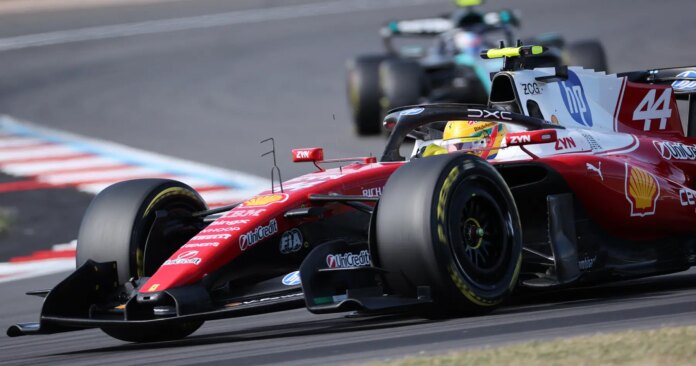
Ferrari has emerged as a surprising contender against Mercedes following the British Grand Prix, particularly evidenced by their performance in sprint qualifying where they set top speeds that eclipsed their competitors. This marks a real shift, disrupting previous expectations about the balance of power between these two storied teams as they head into a critical phase in the FIA Formula 1 World Championship.
This development holds substantial weight within the current landscape of the championship. As reported by GPToday.com, the contrasting performances of the Ferrari SF-26 and the Mercedes W17 during the recent sprint qualifying at Silverstone have illuminated the intricacies of aerodynamic efficiency and energy management, reshaping our understanding of competitive dynamics this season.
How Ferrari’s Aerodynamics Outpaced Mercedes at Silverstone
The unique demands of the Silverstone circuit played a important role in this fascinating comparison. While the Red Bull Ring in Austria emphasised power unit output, Silverstone’s layout rewards aerodynamic efficiency and balanced handling. Consequently, Ferrari’s SF-26 showcased superior aerodynamic properties, allowing it to achieve quicker sector times and higher speeds on the straights while simultaneously utilising less energy from its battery.
The Impact of Battery Clipping on Performance
Data extracted from Lewis Hamilton’s sprint pole lap highlighted a critical aspect of energy management: clipping. This term refers to the phase during which the MGU-K is focused on battery recovery rather than power delivery. The W17 spent nearly two additional seconds in this state per lap compared to its Ferrari rival, indicating a more real reliance on its electrical reserves, which directly affected its performance on high-speed sections of the track.
Efficiency: A Game Changer for the Championship
Insights from recent races point towards a paradigm shift in how power units are assessed. It’s becoming evident that the overall efficiency of a car, rather than peak horsepower in isolation, is becoming more important as the season unfolds. While Ferrari may not yet boast the outright power of Mercedes, the SF-26’s aerodynamic design compensates on tracks like Silverstone, allowing it to conserve energy during cornering and maximise it during straights.
The SportiveNews view
The revelations from the British Grand Prix suggest a profound shift in the competitive landscape of Formula 1, particularly between Ferrari and Mercedes. With a continuously evolving aerodynamic package, Ferrari appears to have unlocked a new competitive edge that may alter its championship trajectory greatly, especially on circuits where efficiency holds a premium.
Frequently asked questions
What factors contributed to Ferrari’s performance advantage at Silverstone?
Ferrari’s performance at Silverstone was strengthened by its SF-26’s superior aerodynamic efficiency, allowing it to attain higher speeds with reduced drag. This efficiency translated to less energy consumption from its battery, resulting in better performance during critical track sections.
How does battery clipping affect a car’s competitiveness in F1 races?
Battery clipping refers to the time spent recovering charge rather than delivering power, which can hinder overall lap times. The Mercedes W17 experienced longer clipping durations compared to the Ferrari SF-26, highlighting the latter’s better energy management and faster lap capabilities in high-speed contexts.
The current climate of the FIA Formula 1 World Championship suggests an intriguing battle ahead, where the nuances of aerodynamics could prove important in determining the season’s outcome. For more insights, follow our comprehensive Formula 1 coverage and stay updated with the latest technical updates.