
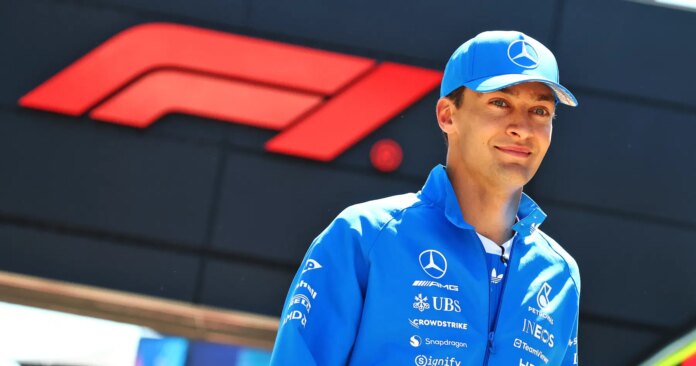
George Russell articulated the widely acknowledged “rule of thumb” regarding F1 qualifying procedures following Carlos Sainz’s provocative suggestion of grid penalties for drivers responsible for yellow or red flags. Russell’s comments shed light on the complexities faced by drivers and officials during qualifying sessions.
As the Formula 1 season unfolds, the implications of qualifying dynamics continue to impact team strategies. George Russell’s insights, shared in response to Sainz’s recent proposal, are reported by GPToday, illustrating the nuanced relationship between flag incidents and qualifying performance.
George Russell’s Insights on Flag Management
Russell emphasised that the differentiation between single and double-waved yellow flags is important in qualifying. The instance that secured him pole position in Austria exemplified this; Russell maintained his time while several others, including Kimi Antonelli, hesitated amid perceived race control signals. This demonstrates how flag management can dramatically influence session outcomes.
Carlos Sainz’s Proposal for Grid Penalties
Sainz’s radical recommendation calls for a punitive system targeting drivers who instigate yellow or red flags. Russell acknowledged the dual effects of such a system: on one hand, it could discourage reckless driving but, on the other, it may stifle the competitive spirit inherent in pushing performance limits. This debate invites broader discussions on how penalties could shape driver behaviour in future qualifying sessions.
The Challenges of Decision-Making in Qualifying
The balance between safety and competition is precarious, as Russell noted the frequent discussions among drivers regarding the adequacy of flag signals following incidents. He cited the Baku Grand Prix as a important point in shifting perspectives, where many drivers argued that stringency should be tempered to preserve on-track battles without imposing excessive penalties.
The Frequent Misinterpretation of Flag Signals
Russell pointed out that marshals, often volunteers, make quick decisions in stressful contexts. The challenge of determining when to display single or double yellow flags is compounded by time constraints; decisions must be made within mere seconds. With the expectation for instant responsiveness, the nuances of each incident complicate the clarity of signals displayed to the drivers.
The SportiveNews view
The ongoing debate surrounding flag penalties signifies a critical intersection of safety and competitive integrity in Formula 1. Russell’s insights reflect the need for continued dialogue about qualifying protocols, which could ultimately shape the trajectory of both drivers and teams this season.
Frequently asked questions
What are Carlos Sainz’s grid penalty suggestions?
Carlos Sainz proposed that drivers causing yellow or red flags should receive grid penalties, aiming to enhance accountability for impacts on other competitors during qualifying sessions. Russell acknowledged both the advantages and potential downsides of this proposal.
Why is flag management real in F1 qualifying?
Flag management is important as it directly influences drivers’ strategies and session outcomes. Russell’s comments highlight how the interpretation of single versus double-yellow flags can impact the performance and decisions of drivers competing for pole positions.
Formula 1 coverage shows how such discussions can shape future regulations, while the implications of flag incidents continue to remain central to the narrative of competitive racing.