
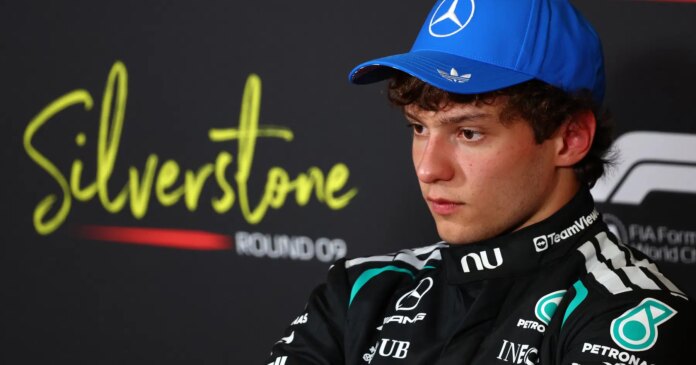
Martin Brundle has called for real reconsideration of F1’s track limits regulations, following a contentious five-second penalty imposed on championship leader Kimi Antonelli during the closing laps of the British Grand Prix. The Italian driver appeared to lose out on a potential podium finish due to this ruling, as he fought against a mechanical issue affecting his Mercedes W17.
This dramatic race incident unfolded while Antonelli was in second place, gaining on race leader Charles Leclerc. On lap 41, a failure of his front-left wheel shield impeded the car’s handling, forcing the young driver to repeatedly leave the track. The fourth off-track excursion resulted in the automatic penalty, despite there being no evidence of a competitive advantage gained from these actions, as highlighted by Brundle’s analysis on Sky Sports.
Understanding Antonelli’s Challenge with the Mercedes W17
As Antonelli wrestled with a damaged car, he had to contend with the repercussions of the existing regulations. This scenario raised pressing questions about the fairness of imposing penalties under circumstances that deviate from standard competitive conditions. The stewards’ decision led to his eventual finish in ninth position being adjusted to sixteenth after the penalty was applied.
Brundle’s Critique of Current Track Limits Regulations
Brundle emphasised that track limits should not serve as penalties when drivers are attempting to navigate damaged vehicles, labelling such regulations as a “performance penalty.” He argued that the aim of track limits should be to deter unfair advantages rather than punish drivers grappling with mechanical failures, thus calling for rule amendments to address these inadequacies.
The Impact of the Safety Car on Race Outcomes
While the Mercedes team accepted the officials’ ruling, Brundle noted that the presence of a late safety car, triggered by Max Verstappen, played a key role in the events that followed Antonelli’s penalty. Without this intervention, Brundle contended that Antonelli may have managed to recover and finished higher, particularly given his pace, which outmatched that of the two drivers from Alpine.
The SportiveNews view
This incident underscores the complexities facing drivers in the current regulation landscape. Kimi Antonelli’s position at the top of the championship, despite the setback at Silverstone, is precarious. Future races will demand both consistency and resilience, with the potential for regulatory shifts hanging in the balance as discussions around track limits continue to develop.
Frequently asked questions
What prompted Martin Brundle’s criticism of F1’s track limits regulations?
Brundle contended that the penalties associated with track limits should not apply when a driver is trying to manage a car under real mechanical distress, suggesting that the current rules do not account for circumstances beyond a driver’s control.
How did Kimi Antonelli’s penalty affect his position in the championship?
Despite receiving a five-second penalty during the British Grand Prix that ultimately dropped him to sixteenth place in the final classification, Antonelli still leads the championship with 179 points, 25 points ahead of his Mercedes teammate, George Russell.
For more on F1 penalties and regulations, visit our Formula 1 coverage. You can also explore the implications of this incident on future races in our latest technical updates.