
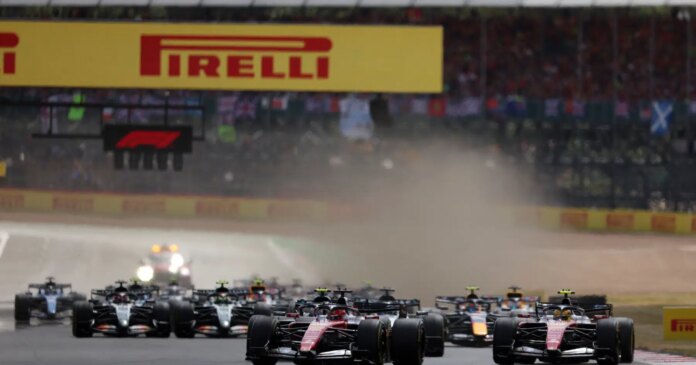
Formula 1’s recent performance at the British Grand Prix has set a remarkable precedent, with an astonishing 18 million viewers tuning in from Brazil alone. This figure not only marks the highest viewership for any single F1 race in Brazil since 2020 but also signifies a real resurgence in audience engagement, particularly for the British event, which had its largest local viewership in eight years.
As reported by GPToday, this surge in Brazilian interest reflects an upward trend in F1’s global television audience this season. The data underscores Brazil’s important role in F1’s ongoing growth and its weight within the larger championship narrative.
Brazil’s Unprecedented Growth Fueled by Local Driver
The revival of F1’s presence on Globo’s free-to-air network, after five years on Band, has been a game-changer for audience numbers in Brazil. The cumulative F1 viewership on Globo this season has already outstripped Band’s total figures for 2025, demonstrating the dramatic impact of this shift. The rising profile of 21-year-old Gabriel Bortoleto, the first full-time Brazilian driver on the grid since Felipe Massa’s retirement, has further catalysed this trend, capturing the attention of the sport’s 71 million-strong fanbase.
Italy and Japan’s lifting Viewership Figures
The excitement surrounding F1 extends beyond Brazil, with Italy also witnessing a remarkable 27% increase in TV audiences up to the British Grand Prix compared to the 2025 season. Ferrari’s competitive SF-26 and Kimi Antonelli’s ascension in the championship rankings have contributed greatly to this spike. Also, the Japanese Grand Prix recorded its highest viewership in Italy since 2017, while the Belgian Grand Prix saw its best numbers in that market since 2019.
China’s Rising F1 Audience and Global Viewership Expansion
China has also seen impressive growth in interest, as viewership figures for the Chinese Grand Prix more than doubled from the previous year, further supported by enhanced coverage and an expanding fanbase. The Monaco Grand Prix, a hallmark event on the F1 calendar, enjoyed nearly 80 million viewers globally, reflecting a double-digit growth relative to 2025.
The SportiveNews view
This remarkable increase in viewership is indicative of a broader resurgence in interest across key markets. The strategic move back to Globo has reimportantised F1’s appeal in Brazil, while the emergence of Bortoleto may be important for sustaining this momentum. As the championship progresses, maintaining viewer engagement will be important for the sport’s long-term growth trajectory.
Frequently asked questions
What factors contributed to the increase in F1’s viewership in Brazil?
The increase in F1’s viewership in Brazil can be attributed primarily to its return to Globo’s free-to-air network after five seasons, enhancing accessibility. The presence of Gabriel Bortoleto, a homegrown driver, has also played a real role in rekindling interest among Brazilian fans.
How has viewership changed in Italy and Japan during the current season?
In Italy, F1’s viewership has surged by 27% compared to 2025, buoyed by Ferrari’s performance and Kimi Antonelli’s success in the championship. Meanwhile, Japan has seen its highest audience figures since 2017 for the Japanese Grand Prix, indicating a growing appetite for F1 in these markets.
For more insights, visit our Formula 1 coverage. Discover the latest happenings in the sport, including driver market rumours and other key developments.